How is Average Annual Return handled for cash?

No Average Annual Returns are shown on the Investing Portfolio page. Is income from cash included in the account return? Does it matter if a money market fund is designated to show or not show as cash? Are sold investments handled as they should be? Are there any known peculiarities that would cause these calculations to deviate from an "all-in" internal rate of return?
Answers
-
If you have those funds recorded in Q as "Cash", there is no return on them. $1 at the start of any period is $1 at the end of that period.
If you have the funds recorded as a MMF, then it's calculated the same as any other security.
Q user since February, 1990. DOS Version 4
Now running Quicken Windows Subscription, Business & Personal
Retired "Certified Information Systems Auditor" & Bank Audit VP0 -
When the Settlement fund in your account earns interest, how is it shown in the register?
I think if it is recorded as a dividend, then the IRR calculation will treat it as a Return and it will be included in the account's Avg Annual Return.
If it is recorded as a Deposit, It will add to both the investments and returns and will not affect the performance.
It is easiest to see this if you look at the Investment Performance Report and check the Show Details box. This will show how each transaction affects the calculation.
QWin Premier subscription0 -
Following along Jim’s comment, you can use transactions like Div, Int, and MiscInc to record the return on the cash in the account. The impact of that return can be seen if within the investment performance report you do not subtotal or subtotal by account. If you subtotal by security, type, asset class, you may not see it.
0 -
Getting some conflicting answers here.
From some rough and uncertain approximations on my accounts, I think NotACPA might be right ("If you have those funds recorded in Q as "Cash", there is no return." If he's right, and you have any significant money market designated as cash, then Quicken's account returns might be seriously wrong, no matter how you look at them.From quick and careless approximations, I think NotACPA might be right. If Quicken is using the entire previous day's balance as principle and ignoring the _Div and _IntInc from securities not listed by name, then the portfolio annualized return could be seriously misleading.
I'm not at all sure about that. I have not tried to match Quicken results by trying different assumptions. I hope someone with more time than I have can confirm or contradict my rough guesstimate that money markets distort the Average Annua Return (%) fractions for an account. If that's the case, the performance comparisons in the Performance tab may also be way off.
0 -
@Jay Gourley What is the real issue here? You make the initial statement "No Average Annual Returns are shown on the Investing Portfolio page." and then jump to wondering about how cash is included.
Perhaps I have identified to source of your concern. Below is a snip showing a portfolio view and an investment performance report for a sample investment account in a test file - all made up data.
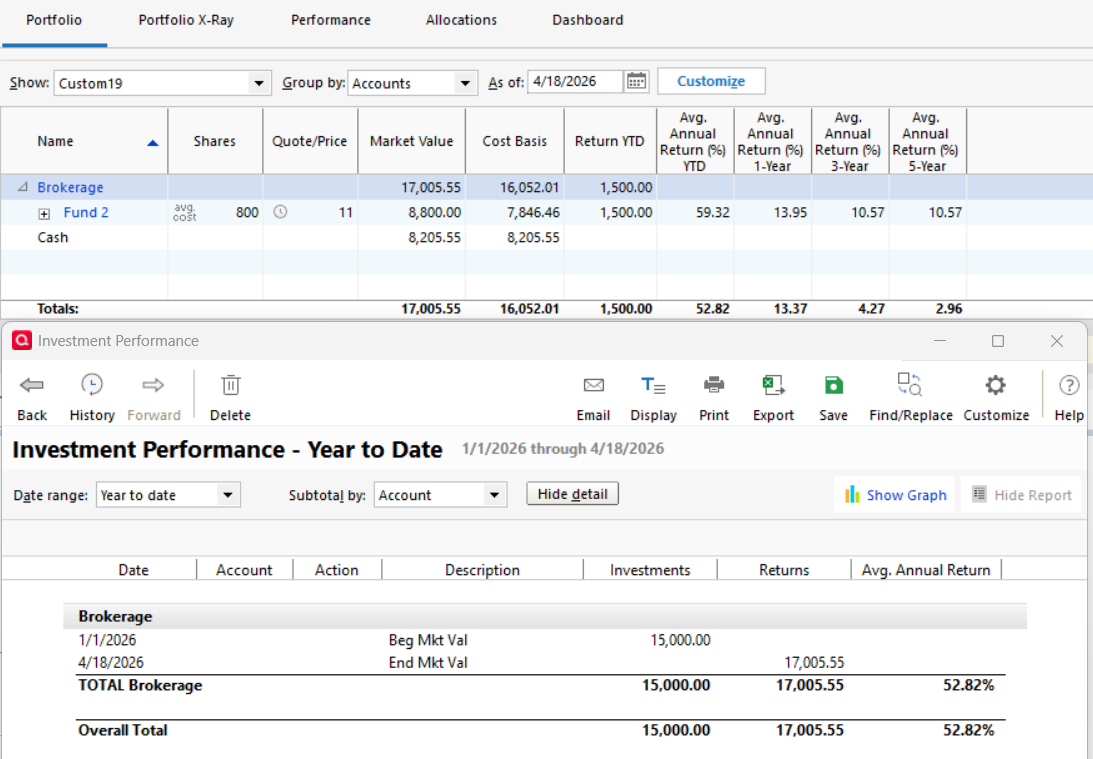
Things to note:
The Portfolio view portion — The average annual return data for the account level are blank (not shown). There is an AAR for the Fund 2 security; there is not for the Cash line. But do note that at the bottom of the portfolio view there is a Totals line. The AAR for that line is different than the Fund 2 line
The Investment Performance Report (IPR) — That shows the beginning and ending market values. In this setup the time frame is YTD. Because no money has gone in our out of the account, there is no other detail. But significant is that the 52.82% matches the Totals line of the portfolio view. If I change the IPR time frame to be 1-, 3-, or 5-years, the percentages likewise match.
In the transaction list for that account I had one transaction as a non-security related Div of $500. If I delete that $500 addition to the cash in the account, the snip changes to:
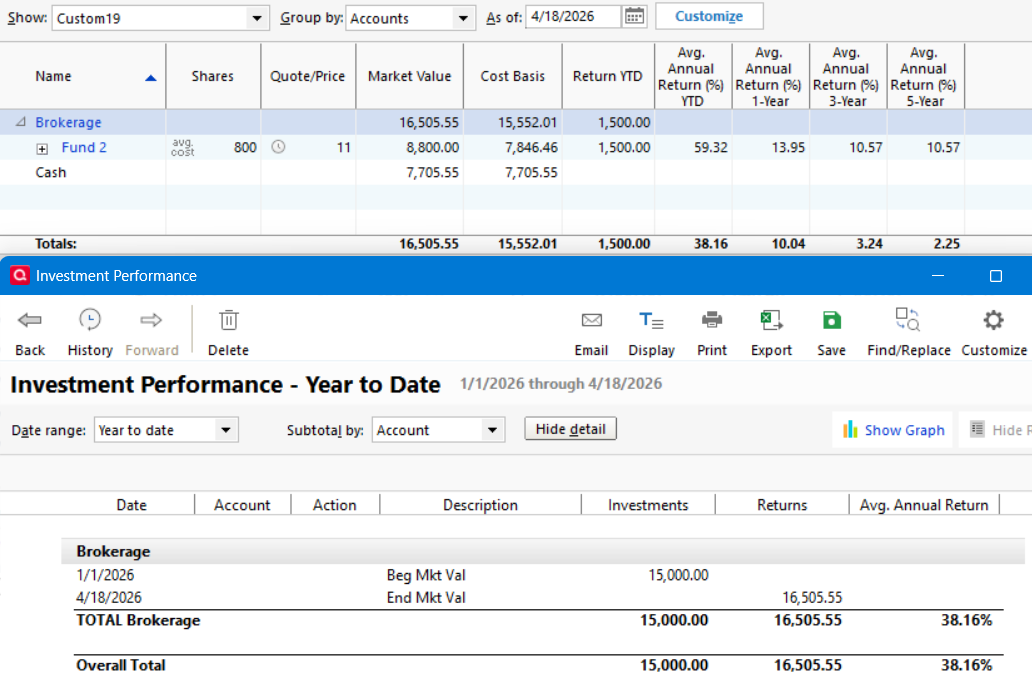
Both the portfolio view and the IPR have changed their YTD values from 52.82% to 38.16%.
CONCLUSION: Cash and cash income is included in the Average Annual Return calculation. Obviously that conclusion is qualified in that the portfolio views and IPRs can be customized on the inclusion of cash and there can be a dependence on how the cash income might be recorded.
What I have not figured out at this point is why in this test file, the Account level AAR values are blank. In my real file, the account level AAR values are sometimes NA (for a currently unknown reason) but mostly have a value.
Follow-up comments: If you maintained the cash in a MM Fund security and were consistent in that operation, you would have a line in the portfolio view that would have AAR values. You would not have a Cash line.
In my example, the dividend transaction had no security identified. That is not particularly significant. Putting in a security for the transaction does not change anything UNLESS the security is one held in the account. That is within my example, if I say the dividend is from Fund 2, the Fund 2 AAR values change but the Totals line does not. Whether I say the dividend is from any other security or blank, the portfolio view does not change.
1